
Davidson County Criminal History Checks
A useful Davidson County criminal records search starts with the product that fits the question. North Carolina eCourts can show a filed criminal case and its court events. The clerk can provide a free terminal view or a certified Davidson name search. The sheriff handles its incident reports and current inmate information. The North Carolina State Bureau of Investigation, or SBI, supplies a fingerprint-supported record only to the person whose history it is. Each source has a different scope, so a clean result in one does not settle what another source may hold.
Gather the full name, spelling variants, date of birth when the portal permits it, and any case or report number. A number is often safer than a common name. Keep the event location in view too. Thomasville reaches into Randolph County, while a Lexington Police narrative remains with that city even if the person later entered Davidson detention.
- Search North Carolina eCourts for a known filed case, using the case number first when it is available.
- Limit name results to Davidson County, criminal case type, status, and a useful date range.
- Open the Case Summary and Register of Actions, then read the disposition rather than stopping at the first charge.
- Use the active inmate list only for current Davidson custody, and request the event report from the agency that made it.
- Ask the clerk for a certified county search or use SBI Right to Review when an official self-check is needed.
Davidson eCourts Criminal Search
Davidson County joined the statewide Enterprise Justice system on October 13, 2025. The public Portal now gives anonymous users several ways to find court records. Registration can save matters under My Cases, but it does not unlock sealed files or sensitive documents. Smart Search is the best first stop for an already filed charge. Search Hearings answers a different need, while Judgment Search narrows judgment entries by status, location, and date.
The official Davidson court location hub connects county users with the current eCourts tools.
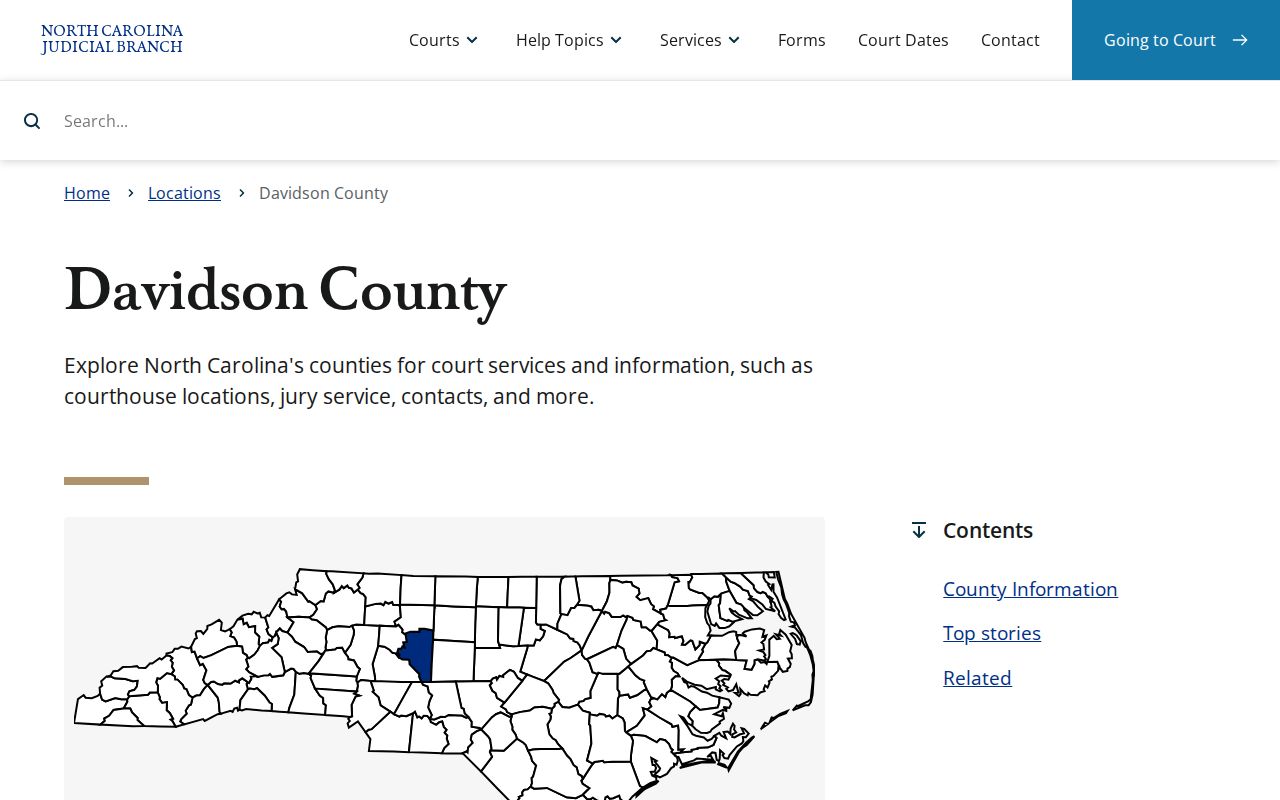
The county hub places calendars, courthouse services, contacts, and Portal guidance in the same official court system.
| Portal module | Useful fields | Best use |
|---|---|---|
| Smart Search | Name, date of birth, case number, type, status, dates | Find a Davidson criminal case |
| Search Hearings | Case, party, attorney, judicial officer, courtroom | Check hearing time and place |
| Judgment Search | Party, case, status, location, judgment date | Review indexed judgments |
Wildcard rules are strict. A person search needs at least three known surname letters plus an asterisk and at least one first-name letter plus an asterisk. If an online search still fails, use the clerk's free public terminal or call about an older paper file. A missing Portal result does not prove that no record exists.
Official Background Checks in North Carolina
North Carolina does not offer a public SBI name-query portal. The SBI Right to Review is a subject-only process for a person's own fingerprint-supported North Carolina arrest history and associated dispositions when available. It is not a national search. The FBI Identity History Summary is the separate national self-review route. For Davidson County court records, the clerk can conduct a certified name search for the requester or another named person, but that product is a county court-index result rather than an SBI biometric record.
The clerk search costs $25 and uses form AOC-CR-314. A public courthouse terminal can instead display and email noncertified statewide court results at no search charge, though printing may cost. The SBI self-review costs $14 and requires a full ten-print card, application, and certified check or money order sent by mail. The difference matters: name searches can join the wrong person, while fingerprint comparison is the state's positive identity method.
| Official product | Cost | Coverage |
|---|---|---|
| Clerk terminal view | No search fee | Noncertified statewide court index |
| Certified clerk search | $25 | Davidson County court records |
| SBI Right to Review | $14 | Subject's fingerprint-linked North Carolina history |
| FBI self-review | $18 | Subject's national identity history |
The Judicial Branch certified-search instructions illustrate the county court route.
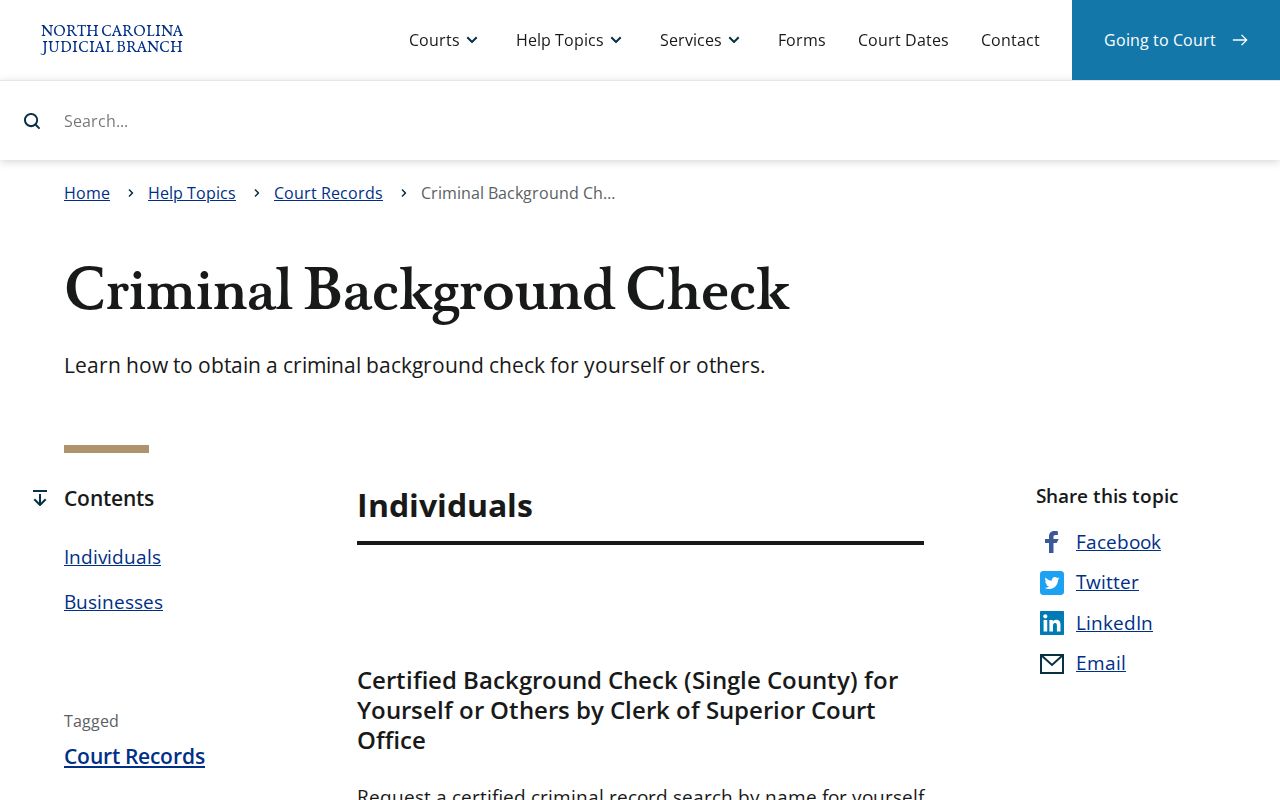
This route is useful when certification matters, yet it must not be described as a complete state rap sheet.
Davidson Fingerprint Record Review
Davidson County residents and people who work in the county may obtain fingerprints from the Sheriff's Office at 2511 E US Hwy 64 in Lexington. Walk-in printing is offered Monday through Friday from 8:30 a.m. to 4 p.m., excluding holidays. Bring valid identification and proof of county residence or work. A Live Scan customer must also bring the authorized agency's Electronic Release Form.
An ordinary SBI Right-to-Review applicant mails the completed form, ten-print card, and $14 certified payment to the SBI Applicant Unit at PO Box 29500, Raleigh, NC 27626-0500. The SBI allows up to 20 business days and does not offer walk-in or expedited service. Results go to the subject, not straight to a third party. If an SBI disposition is missing after the clerk record is fixed, the Written Exception process routes the correction to the SBI unit that maintains the state history.
The SBI personal-review page identifies the proper fingerprint-supported self-check.
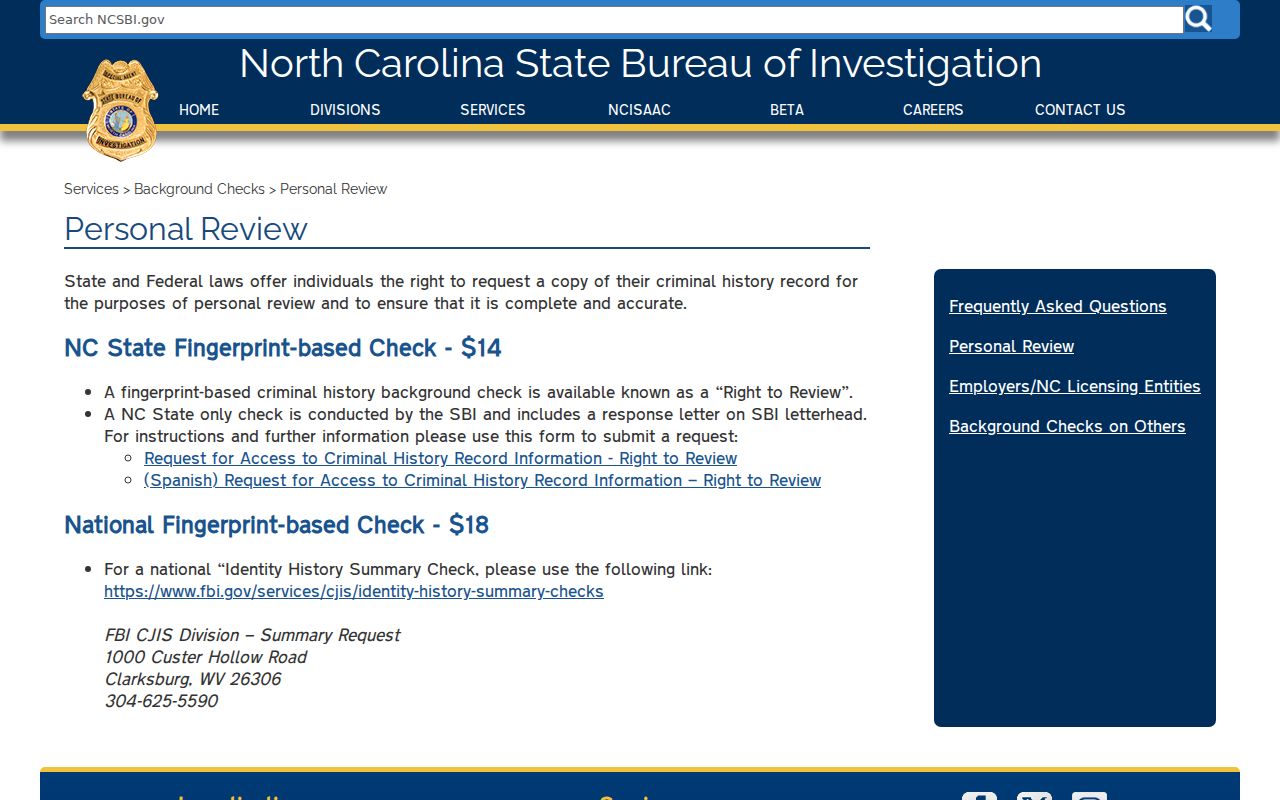
The image reinforces the key limit: this channel reviews the subject's own North Carolina repository record.
Kinds of Criminal Records
Davidson County criminal history is assembled from records made at different stages. A police or sheriff report describes a reported event and the agency's work. An arrest and booking entry shows apprehension and custody. A clerk file shows filed charges, hearings, pleas, dispositions, and sentences. SBI history links fingerprint-supported arrest cycles with dispositions received by the repository. NCDAC supplies a correctional or community-supervision view, while the registry has its own statutory public fields.
Those records should be matched, not blended. The report custodian may lawfully withhold investigative material while releasing public incident facts. A current inmate row can vanish after release. The case may continue and end in dismissal or conviction. SBI may receive the outcome later, and an expunction follows a separate court process.
- Incident report: the reported event and releasable facts held by the investigating agency.
- Booking record: current custody and offense rows, not a finding of guilt.
- Court file: filed charges, events, hearings, disposition, and sentence.
- Repository history: fingerprint-linked North Carolina arrest cycles and available outcomes.
- Correctional or registry entry: the specific custody, supervision, or registration status that agency publishes.
For a source view of local records work, the Sheriff's Technical Services information explains report, warrant-processing, and fingerprint functions.

It shows why sheriff records and state court records remain separate even when they concern the same event.
Davidson Current Custody Records
The Davidson Active Inmate List answers whether a person is in current county custody and which offense rows appear with that booking. The printable offense list can show a booking number, a separate Name Number, statute, offense text, court code, a four-digit offense code, and a broad F or M label. One booking may carry several charge rows. Those numeric fields are not interchangeable with an eCourts case number.
The sheriff warns that custody information does not reflect criminal history or criminal status. A released person may no longer appear, and Davidson County has no verified public historical booking archive. For an older arrest, request the agency report, then use eCourts or the clerk for the outcome. NC SAVAN provides custody notification, but it is not a case file. The sheriff reports about 6,000 bookings per year and an average daily population above 280; neither number states the jail's rated capacity.
The official Sheriff's homepage is the source gateway for Davidson County criminal reports and custody contacts.

Use that agency route for sheriff-created records, then move to the clerk when the question concerns prosecution or outcome.
Note: An active booking entry records custody and alleged charges, not a conviction or a complete Davidson County arrest history.
Davidson County Criminal Records: What They Contain
The content depends on its custodian. A Davidson County criminal court file may contain a case number, parties, assignments, events, hearings, disposition, and financial details when data exists. A booking record uses custody identifiers and charge rows. SBI history centers on fingerprint-linked arrest cycles. The correct identifier is vital because a booking number, Name Number, police report number, SBI number, and Enterprise Justice case number serve different systems.
| Name & identifiers | Party name plus the source system's case, report, booking, or biometric identifier. |
|---|---|
| Arrest / booking data | Custody entry, booking number, reported offenses, and broad F or M classification when published. |
| Charges & statutes | Alleged or filed offenses and statutory references, which can change before disposition. |
| Case events | Assignments, appearances, hearings, pleas, and motions recorded by the clerk. |
| Disposition | Dismissal, plea, trial outcome, or other final resolution shown in the court source. |
| Sentence or status | Court sentence, county custody, or NCDAC supervision data, depending on the record. |
A charge is not the same as a disposition. Even a guilty plea with time served is a conviction, while a successful conditional discharge may end in dismissal. An infraction is processed through criminal court but is not itself a crime. Read the last reliable event and confirm unclear codes with the clerk.
Correcting Davidson Criminal Records
Begin with the office that created the disputed fact. Ask the investigating agency about an event narrative, the jail about custody data, and the Davidson Clerk about a judgment or disposition. A repository record should not be corrected by guessing from a Portal screen. First secure the court source, then use the SBI Written Exception process if the fingerprint-supported history still lacks or misstates the result.
The same source-first rule applies after expunction. An order can move to the court, law enforcement, NCDAC, DMV, and other named agencies, but propagation is not always instant. If a granted case still appears, contact the clerk that entered the order and the office displaying the residue. A public search result should not be treated as more authoritative than the signed disposition.
- Disposition
- The court's recorded outcome for a charge or case.
- Dismissal
- An end to a charge without conviction; it does not by itself erase every agency record.
- Expunction
- A North Carolina court remedy that removes qualifying records from ordinary public access under specific statutes.
- Written Exception
- The SBI process for challenging a subject's fingerprint-supported repository history.
North Carolina Public Access Laws
The North Carolina Public Records Law begins with a broad definition of records made in public business, then draws firm limits around criminal investigations. Davidson County must allow inspection and copies of public material at reasonable times and under reasonable supervision. Copies normally cost actual expense, though an unusually large request can bring a special service charge. A requester may ask for an estimate before the work proceeds.
Investigative and intelligence files are generally not public in full. Yet state law keeps key facts open, including the time, date, location, and nature of an apparent violation, information about a charged person, circumstances surrounding an arrest, and the status of an investigation. This is why a Davidson report response may be narrower than the complete officer narrative.
Key North Carolina laws:
Chapter 132 defines the state's public-record framework.
G.S. 132-1.4 separates public incident facts from generally nonpublic investigative files.
G.S. 132-6 governs inspection and prompt copies.
G.S. 132-6.2 limits ordinary copy charges to actual cost and permits certain service charges.
G.S. 14-208.10 identifies public registry fields and permits written sheriff requests.
Davidson Warrant Record Fallbacks
No verified general-public Davidson County or statewide master warrant search exists. The inmate roster is not a warrant database, and a blank eCourts result is not proof that no warrant is active. Davidson's Warrant Squad tracks and processes active arrest warrants, while criminal magistrates issue process, conduct initial appearances, and set release conditions.
Use a cautious fallback chain. Call the Sheriff's main line at (336) 242-2105 or nonemergency line at (336) 249-0131. Criminal magistrates can be reached at (336) 242-6717. A known case may show hearings or an order for arrest in eCourts, and a sheriff records request may produce releasable facts. Calling ahead or consulting counsel is safer than arriving without notice merely to test warrant status.
A summons and a warrant both follow a finding of probable cause, but they direct different acts. A summons orders the person to appear. A warrant commands arrest. Missing court can also produce an order for arrest, bond forfeiture, added fees, license consequences, or a new charge. North Carolina has no municipal court portal for Lexington, Thomasville, or Midway.
Restricted, Sealed & Expunged Records
North Carolina calls the record-clearing remedy expunction. A petition normally goes to the clerk in the county where the case arose. The general filing fee is $175, while several dismissal and not-guilty remedies have no fee unless a specified diversion or deferred prosecution produced the dismissal. The process can take months because agencies must run checks and a hearing may be needed. The clerk can give local filing and schedule information but cannot offer legal advice.
Chapter 15A, Article 5 contains remedies for defined youthful matters, certain nonviolent convictions, mistaken identity, DNA relief, qualifying dismissals and acquittals, and other narrow grounds. Some qualifying cases disposed on or after December 1, 2021 can be expunged by operation of law 180 to 210 days after final disposition under G.S. 15A-146, subject to exclusions. The result is not the same as deleting every confidential official file. Statutory access can remain.
The Judicial Branch expunction overview links the remedies and forms.
Note: A dismissal may support an expunction path, but dismissal alone does not automatically erase every Davidson County police, booking, or repository entry.
Davidson Offender Supervision Records
Probation, parole, post-release supervision, and prison records add another layer. Davidson County does not operate a county probation department. North Carolina Department of Adult Correction Community Supervision runs probation and post-release work, while the Post-Release Supervision and Parole Commission makes the relevant parole and post-release decisions. The trial court, not the supervision office, imposes probation.
The public NCDAC locator can show correctional or supervision status, but the Davidson Clerk's judgment remains the source for the sentence and court conditions. Neither source substitutes for county-jail custody. When a status is unclear, compare the locator with the judgment, then use an NCDAC public-record request or the Community Supervision channel for information the agency can release.
The NCDAC Public Offender Search supplies the state correctional layer.
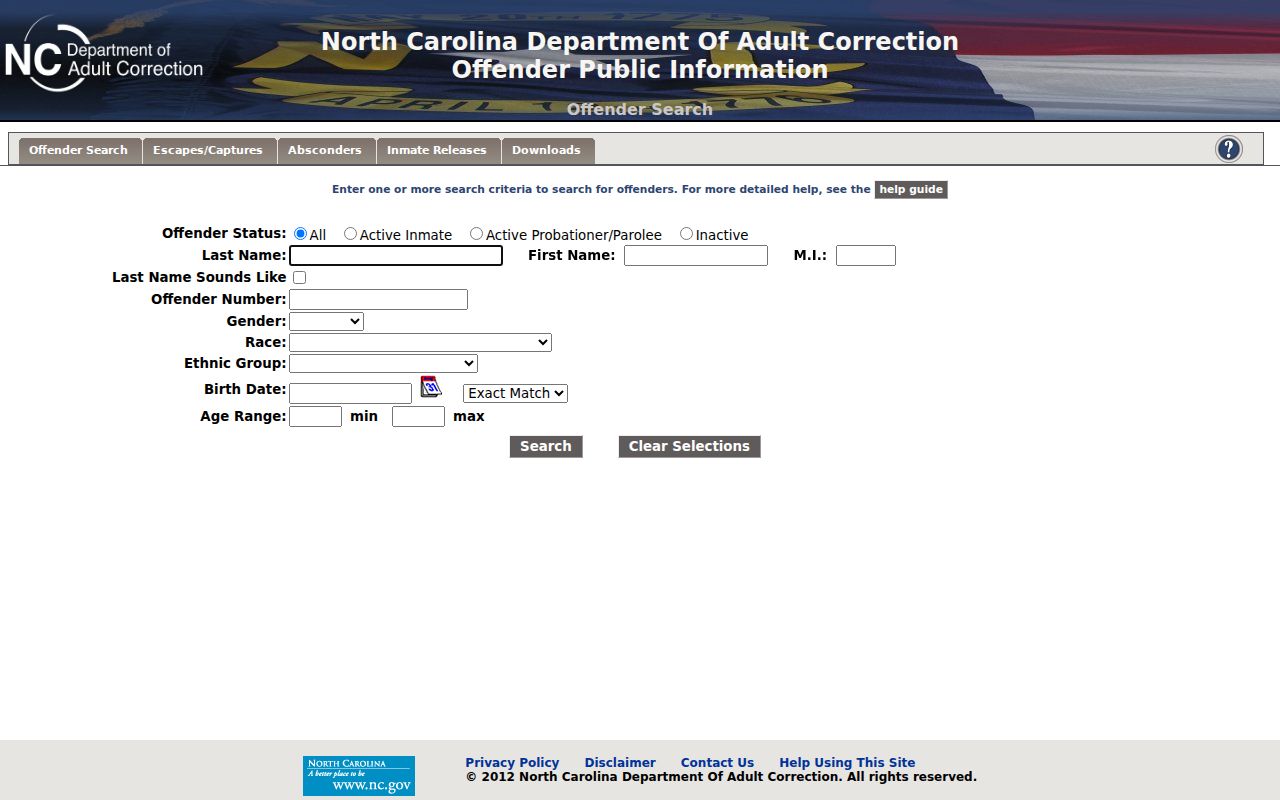
The locator should be read as a focused custody or supervision source, not as a complete Davidson criminal history.
Davidson Criminal Record Offices
Three local offices cover most Davidson County criminal record needs. The clerk holds District and Superior Court files and handles certified searches. The Sheriff's Records Division processes DCSO investigations, arrests, and related reports. The Thomasville court branch provides a second state-court location, though its official page does not promise that every paper file is stored there. Call before making a trip for a specific file.
The official Lexington courthouse page shows the main Davidson court records location.
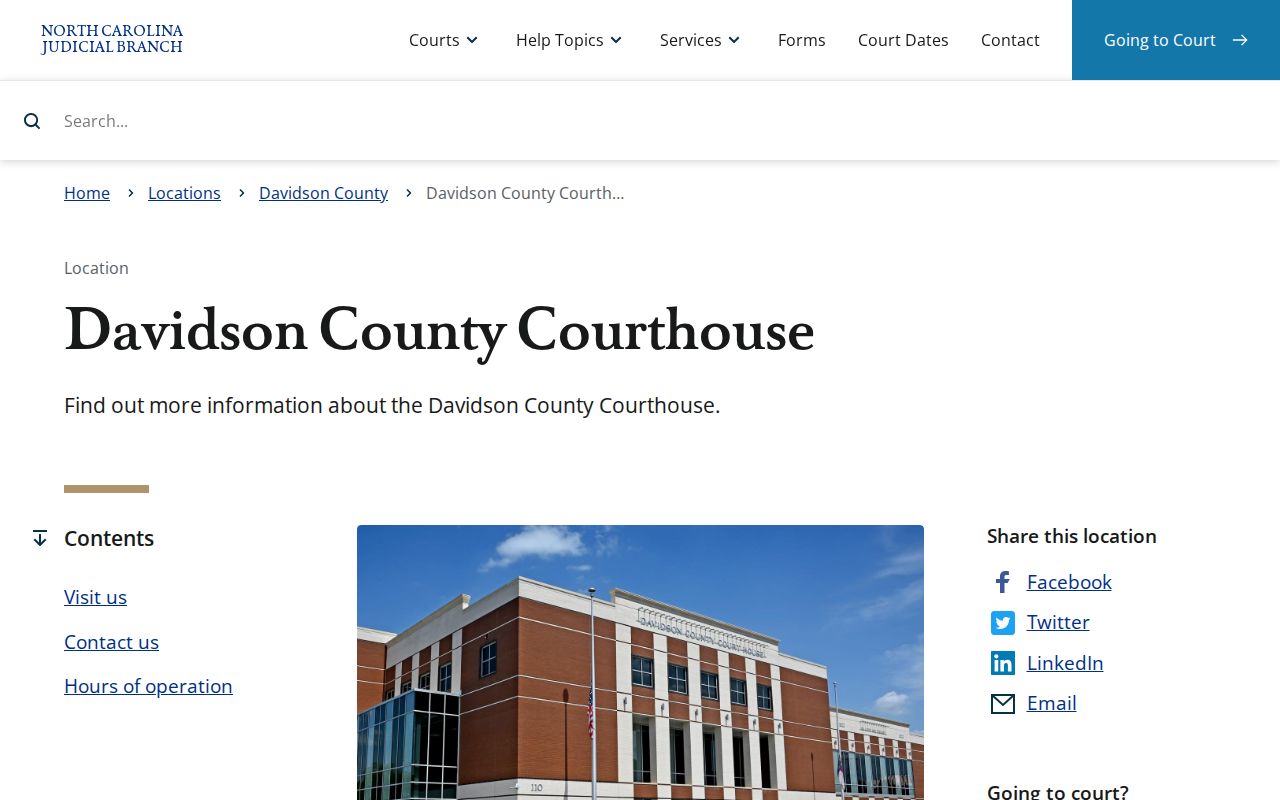
This courthouse is the shared clerk point for Superior and District Court records, rather than a separate city court.
Davidson County Clerk
110 W Center St
Lexington, NC 27292
(336) 242-6701
Weekdays, 8:30 a.m.-5 p.m.
Sheriff's Records Division
2511 E US Hwy 64
Lexington, NC 27292
(336) 242-2105
Report requests use the official web gateway.
Thomasville Court Branch
22 Randolph St
Thomasville, NC 27360
(336) 474-3185
Weekdays, 8:30 a.m.-5 p.m.
Sheriff online requests should identify the record type and relevant dates, names, or case number. The published target is email delivery in three to five business days. No direct Records email, report fee, mail route, or certified report product was published, so current terms should be confirmed with the office.
City-by-City Criminal Records in Davidson County
City geography changes the first custodian, not the state court structure. Thomasville Police holds its own incident material and serves a city that crosses into Randolph County. Lexington Police has a defined email copy route, while the Davidson courthouse sits nearby as a separate records office. Midway has no police department and contracts with the Davidson County Sheriff. None of the three has a municipal court; criminal matters move through North Carolina District or Superior Court.
Thomasville Record Check
28,082 residents in the 2024 OSBM estimate; confirm the incident county before choosing a sheriff or clerk.
Lexington Record Check
20,256 residents in the 2024 OSBM estimate; police copies, city records, and court files use three distinct channels.
Midway Record Check
5,053 residents in the 2024 Census estimate; DCSO provides round-the-clock law enforcement under contract.
The city pages keep local report channels at full depth while routing filed charges and final outcomes back to the correct county clerk.