
Lexington Criminal History Checks
Begin with the record's source. A Lexington officer's narrative belongs to police records. The booking record belongs to the detention agency. Filed charges, hearing dates, and dispositions belong to the North Carolina courts. General City Hall records cover public city business but do not replace any of those criminal justice files.
- Email Lexington Police records when seeking an existing police report copy and allow the published five-business-day period.
- Use the city's Chapter 132 request process only for general municipal records outside the police-copy route.
- Check Davidson County Sheriff's active list for current custody, then confirm that a booking actually occurred.
- Search North Carolina eCourts or ask the Davidson Clerk for the filed case and outcome.
- Use SBI Right to Review when reviewing your own fingerprint-supported North Carolina history.
These sources answer distinct questions. A police allegation can exist without a booking. A booking does not prove conviction, and a court dismissal does not by itself erase every agency record.
If the case number is known, eCourts gives the most direct route to the judicial file. A person searching by name can use Davidson County, criminal case type, status, date, and other filters. Public courthouse terminals also permit free statewide viewing and emailing, while printed copies may carry a charge.
Three Lexington Record Counters
Lexington's records offices sit close together, which makes them easy to confuse. City Hall at 28 W Center Street handles general municipal business. City Centre is at 200 N State Street. The Davidson County Courthouse and Clerk are at 110 W Center Street. Similar downtown addresses do not mean the offices share files.
| Office | Records to request | Records it does not hold |
|---|---|---|
| Lexington Police | Police incident and arrest report copies created by LPD | State court judgments |
| City Hall | General city administration records under Chapter 132 | LPD investigative narratives and court files |
| Davidson Clerk | District and Superior Court cases, events, and dispositions | Police investigative narratives |
Send a request straight to the custodian. That saves staff from rerouting it and reduces the chance that a narrow answer will be mistaken for a full Lexington criminal history.
Records at Lexington Police Department
Lexington Police directs copy requests to policerecords@lexingtonnc.gov and says to allow five business days. The published records-page phone is (336) 243-2489. The email is meant for copies of reports that already exist.
It cannot create a new incident report. Call (336) 243-3302 for a new nonemergency report and 911 for an emergency. For a copy, include a known report number, event date and location, involved party, and the specific record type. Clear facts help records staff locate the right file without collecting needless sensitive detail.
Lexington Police Records
Email: policerecords@lexingtonnc.gov
Records page: (336) 243-2489
New nonemergency report: (336) 243-3302
Allow five business days for a copy request.
Lexington Police Record Staffing
The official department profile describes 60 sworn personnel, 11 civilian personnel, 5 reserves, and 4 school guards. Its structure includes Uniformed, Investigations, and Administration. City budget material separately identifies a Records and Information function with four Police Information Technicians.
Those facts show that records work is a defined function inside Lexington Police, but they do not support inventing a records commander or direct office address. Use the published email and phone. Investigative material may be reviewed for lawful withholding or redaction before release even when public incident facts are available.
The department's three-part structure also helps route a precise request. Uniformed staff may create the first incident record, Investigations may add protected working material, and the Records and Information function manages the copy channel. Naming the event date, location, involved party, report number, and desired public record gives the technicians usable search facts. It does not expand the material state law permits them to release. A copy response may therefore contain public incident facts while leaving investigative detail out.
Note: The five-business-day instruction applies to police copies, not emergency response or a new incident report.
Booking and Arrest Records in Lexington
LPD keeps the police report from an arrest made by its officer. Davidson County detention creates a separate booking if the person is accepted into county custody. The sheriff's active inmate search is useful for current custody, but no official blanket statement proves every Lexington arrest will appear there.
Check the roster, then use the police report for the event narrative and eCourts for the case result. A released person may no longer appear because the list is current, not a historical Lexington booking archive. For more detail on custody fields and sheriff requests, use the Davidson County arrest search.
After prosecutors file a charge, the clerk record may show an amended count, dismissal, plea, trial result, or sentence that the first arrest entry could not predict.
The county roster may list more than one charge under a booking and uses a booking number that is not the same as a court case number. Broad F or M labels mean felony or misdemeanor, not the final offense class, sentence, or result. Carry the charge wording and case identifier forward to the clerk search.
Lexington Crime Records by Number
Lexington Police reported 674 index offenses for 2024. SBI's agency table breaks that total into 4 murders, 7 rapes, 17 robberies, 59 aggravated assaults, 127 burglaries, 400 larcenies, and 60 motor-vehicle thefts. Larceny was the largest category.
Agency counts measure reports under defined crime categories. They are not a list of residents, arrests, open court cases, or convictions. Use them to understand the volume and mix of police reporting, not to decide what happened in an individual Lexington criminal case.
The Lexington Municipal Court File
Lexington has no municipal court file because North Carolina has no separate city court system. City ordinance and traffic matters that enter the criminal process go through state District Court. Felony trials go through Superior Court. Both are part of the unified General Court of Justice.
| Court Name | North Carolina District Court and Superior Court in Davidson County |
|---|---|
| Case Types Heard | District Court handles misdemeanors, infractions, and early felony stages; Superior Court handles felony trials |
| Case Lookup Channel | North Carolina eCourts Portal, courthouse public terminal, or Davidson Clerk request |
| What the Docket Shows | Charges, parties, events, hearings, disposition, and available financial entries |
| Copies & Fees | Ask the Clerk for copy costs; the certified Davidson criminal record search is $25 |
The courthouse at 110 W Center Street is the state case counter. It should not be confused with City Hall at 28 W Center Street.
Lexington Court Records Uptown
Lexington was settled in 1775, incorporated in 1828, and has been the Davidson county seat since 1847. That history helps explain why the Clerk, District Court, Superior Court, prosecutor, and magistrate contacts cluster around the courthouse downtown.
The county-seat role does not merge city and county custodians. Lexington Police still owns its investigative reports. The Clerk owns court cases. The sheriff owns county custody records. Large late-October festival activity may affect downtown travel, but no official source supports assuming the courthouse closes for it. Check the court calendar and call before a time-sensitive visit.
That compact geography is useful once each address is matched to its job. A reader can confirm a police report through LPD, use the clerk for the filed case, and consult the sheriff only if county custody is at issue. City Centre at 200 N State Street should not be substituted for either the police copy route or courthouse counter. When a request crosses those lines, split it into separate questions and keep the report number, booking identifier, and court case number distinct.
How Lexington Records Reach the County
A Lexington officer creates the city report. If the person is booked in Davidson detention, the sheriff creates a custody record. A prosecutor's filing creates a separate District or Superior Court matter, and the clerk records hearings and outcome. Fingerprinted arrest data and available dispositions can later feed SBI.
Record flow: Lexington Police Department › Davidson County detention › Davidson County courts › North Carolina State Bureau of Investigation
Timing can cause gaps. For a recent event, begin with police and custody sources. For an older matter, the court disposition matters most. If your own SBI record lacks that disposition, correct the clerk source first and then use SBI's Written Exception process.
Lexington Public Record Form
The Lexington public information request covers general city records. Its fields include requester name or other identification, contact information, request date, a specific description, and signature. Staff track copy count, amount due, fulfillment date, and completing employee.
The city processes requests in order received. Legal review and high volume can add time or cost under the adopted fee schedule, and a requester may need to sign before release or collection. The City Clerk fallback is at 28 W Center Street, (336) 248-3910, EMJackson@LexingtonNC.gov, weekdays 9 a.m. to 4 p.m.
This form does not displace the police report email. Use the form for city administration and the police route for LPD copies.
A broad request can take longer when staff must search many files or obtain legal review. Narrowing the date span, department, subject, and desired format helps define the work. If copies will be numerous, ask for the amount before collection. Chapter 132 allows actual-cost charges and, in qualifying cases, a special service charge for extensive labor or technology use.
Lexington State Criminal Record Checks
The North Carolina SBI services page identifies the state repository channel.
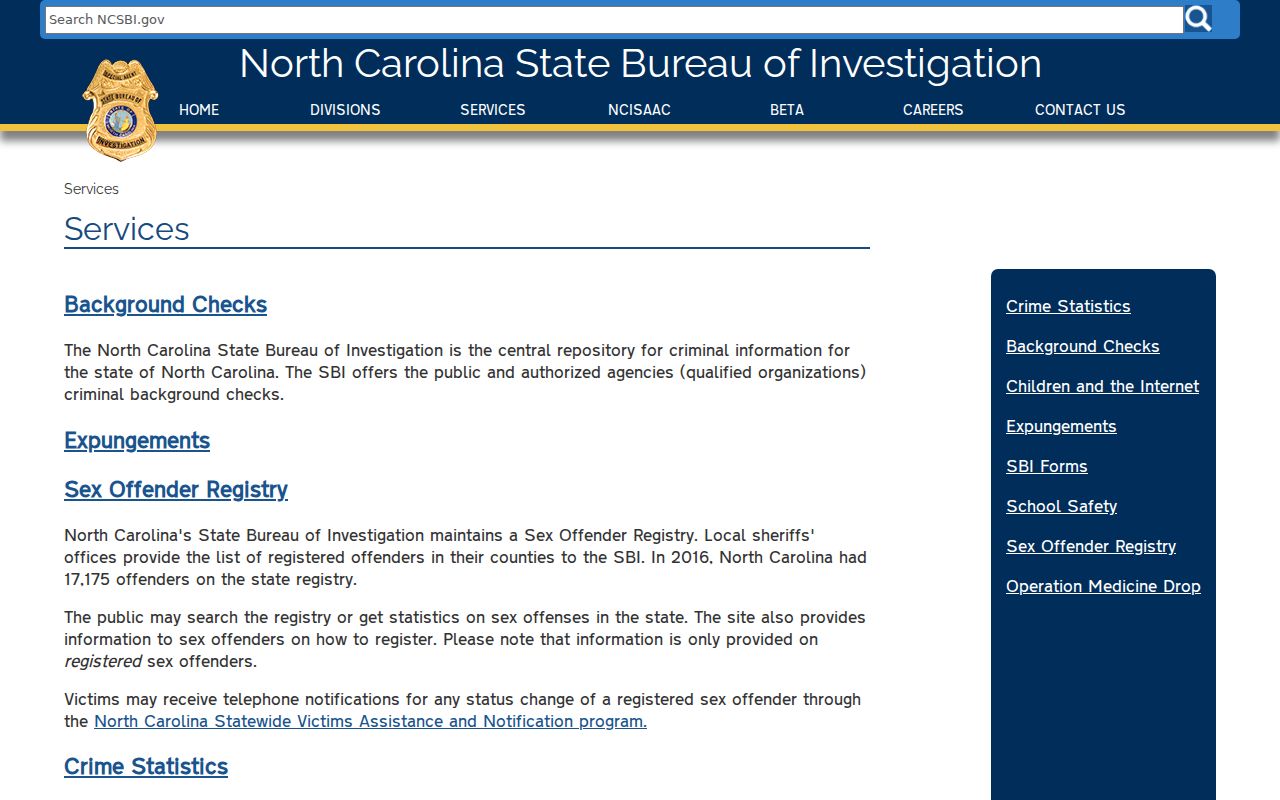
SBI does not offer a public name-search portal. Its Right to Review is for the subject's own fingerprint-supported North Carolina history. The person sends a ten-print card, application, and $14 certified check or money order. It can contain North Carolina arrests and available dispositions, but not other states or a national result.
The SBI background check explanation distinguishes official alternatives.
A Davidson Clerk search costs $25 and checks county court records. It is not the SBI fingerprint repository. Free public courthouse terminals can show statewide court entries without certification.
Lexington Record Access Rules
North Carolina Public Records Law applies to Lexington city records, but criminal investigations receive special treatment. Public facts can include the time, date, place, and nature of an apparent violation, information about a charged person, circumstances surrounding an arrest, and investigation status. The full police narrative is not automatically public.
Key Statutes:
Chapter 132 defines and governs North Carolina public records.
G.S. 132-1.4 separates public incident facts from nonpublic criminal investigative material.
G.S. 132-6.2 limits ordinary copy charges to actual cost and allows certain special service charges.
Ask staff to identify the public portion if part of a Lexington report is withheld. Court rules separately restrict sealed, expunged, juvenile, and confidential material.
Correction also follows the custodian map. Bring incident facts to Lexington Police, custody data to the sheriff, and a judgment or disposition error to the Davidson Clerk. For your own state repository history, correct the source first and then submit SBI's Written Exception process if the fingerprint-linked entry remains wrong or incomplete.